If you have been following tech news lately, you have probably heard the term "AI agent" thrown around constantly. But between the hype and the jargon, it can be hard to understand what an AI agent actually is and why it matters. Let us break it down in plain language.
The Simple Explanation
Think of the AI tools you already know — like ChatGPT or a virtual assistant. You ask a question, you get an answer. That is a chatbot. It responds to your prompts, one at a time, and waits for you to tell it what to do next.
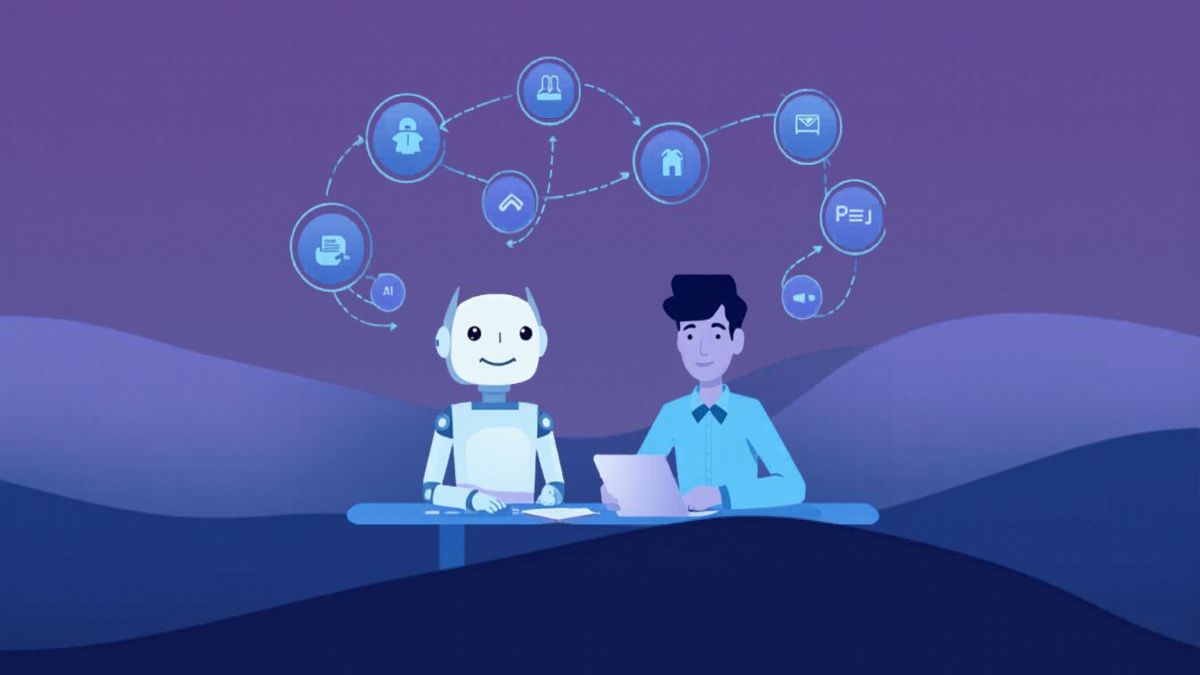
An AI agent is different. Instead of just answering questions, an AI agent can take action. You give it a goal, and it figures out the steps to get there — planning, executing, and adjusting along the way, often without needing your input at every step.
A Real-World Analogy
Imagine the difference between asking a friend for restaurant recommendations versus hiring a personal assistant to plan your entire dinner. The friend gives you suggestions and you do everything else. The assistant researches options, checks availability, makes a reservation, sends you the confirmation, and even arranges transportation. That assistant is the AI agent.
What Can AI Agents Actually Do?
AI agents can connect with various apps and data sources, execute multi-step tasks autonomously, make context-driven decisions within set guardrails, and coordinate with other systems to complete complex workflows.
For example, an AI agent could handle your entire travel planning: research flights and hotels based on your preferences, compare prices across platforms, book everything using your payment information, and send confirmations to your calendar — all from a single request.
In business, the applications are even more powerful. AI agents can monitor inventory levels, automatically reorder supplies when stock runs low, negotiate with vendors, and update your accounting system — all without human intervention.
Agents vs. Chatbots: The Key Differences
A chatbot waits for your prompt and responds. An AI agent takes initiative. A chatbot works within a single conversation. An agent can work across multiple applications and data sources. A chatbot gives you information. An agent takes action on your behalf. A chatbot forgets context between sessions. An agent maintains memory and learns from past interactions.
Why Should You Care?
The shift from chatbots to agents represents a fundamental change in how businesses can leverage AI. Instead of AI being a tool you interact with, it becomes a digital worker that operates alongside your team.
A spring 2025 survey found that 35 percent of organizations had already adopted AI agents, with another 44 percent planning to deploy the technology soon. Jensen Huang, CEO of NVIDIA, recently painted a picture of organizations with 100 AI agents for every human worker — each handling specialized tasks autonomously.
The Challenges Ahead
AI agents are not without limitations. Trust and oversight remain critical concerns — how do you verify that an agent is making good decisions? Security is another challenge, since agents that can take actions on your behalf also represent potential risks if not properly governed. And integration complexity means that building effective agents requires deep understanding of both the AI technology and the business processes they will automate.
Getting Started
If you are considering AI agents for your business, start small. Identify repetitive, rule-based processes that consume significant time. These are ideal candidates for agent automation. Work with developers who understand how to build agents with proper guardrails, monitoring, and fallback mechanisms.
The age of AI agents is here. Understanding what they are — and what they are not — is the first step toward using them effectively.